What Is an I-MELD? The Business Introduction Framework
Apr 10, 2026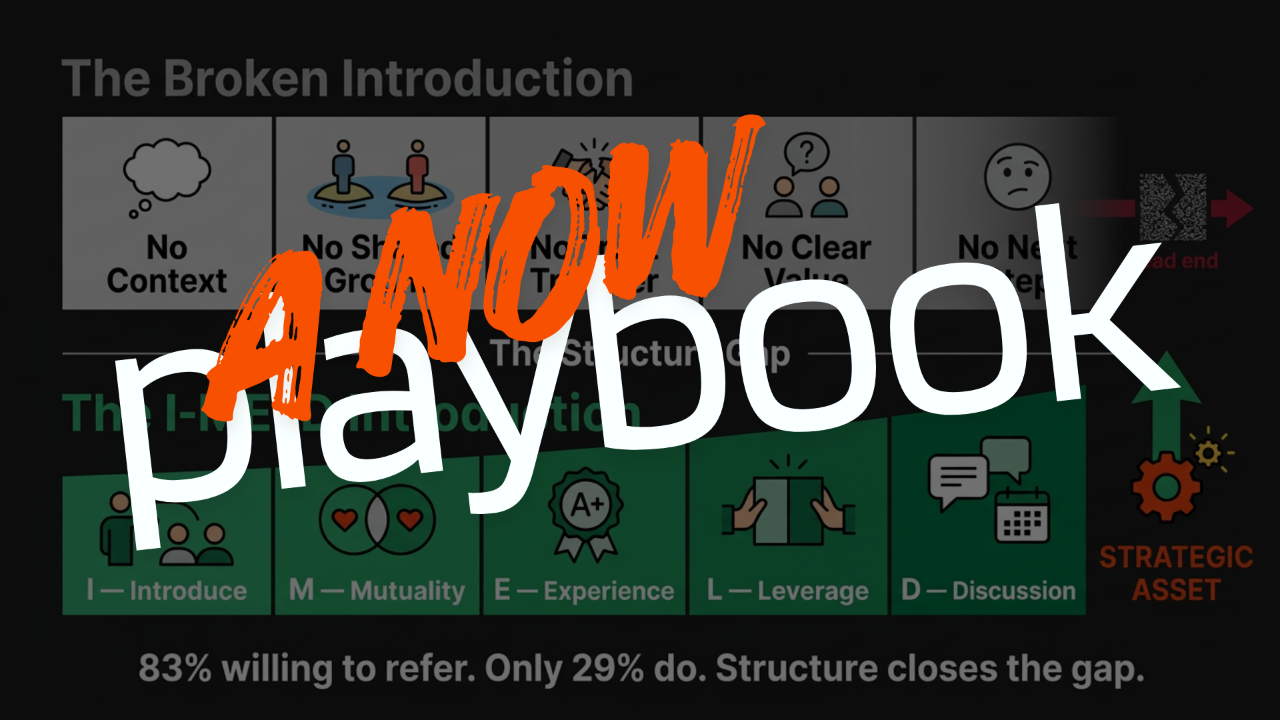
What Is an I-MELD? The Business Introduction Framework
Most business introductions fail not because of bad intent but because of missing context. The I-MELD framework solves this by requiring five elements before any introduction is made: Introduce (the basic framing), Mutuality (the shared ground that makes the connection worthwhile), Experience (relevant context about each party), Leverage (the specific opportunity the connection creates), and Discussion (the proposed first step). The Mutuality element is the most commonly skipped and the most critical — without a clear articulation of why these two people have a genuine reason to know each other, the introduction is just an email connecting two strangers.
Why Do Most Business Introductions Fail?
Someone connects two people via email. Subject line: "You two should meet."
The email sits in both inboxes. Nobody's sure who should respond first. Nobody's sure what the actual connection is. A week later it's buried.
That's not an introduction problem. That's a structure problem. Most business introductions fail because they contain the people but not the context.
The missed opportunity is significant. Research from Firework shows that 83% of consumers are willing to make a referral — but only 29% actually do. The gap between intent and action almost always comes down to a lack of structure. The I-MELD framework closes that gap.
What Does I-MELD Stand For?
I — Introduce:
Who is being introduced to whom, with enough context that both parties understand why this is worth their time. Not just names and titles — a sentence that establishes relevance immediately.
M — Mutuality:
The shared ground between the two parties. Overlapping ICP, complementary services, shared values, or a specific client scenario where both benefit. This is the why. Without it, the introduction is just a connection request dressed up as a favour.
E — Experience:
The introducer's direct experience with both parties. Why they trust each person. What they've seen them do. This is the credibility transfer — the reason the introduction carries weight.
L — Leverage:
The specific value each party can offer the other right now. Both parties enter the conversation knowing what they can give and what they're likely to receive.
D — Discussion:
The suggested next step. A specific conversation topic, question, or action that gives the introduction somewhere to go. Without a Discussion prompt, even a well-structured introduction can stall.
Why Does Structure Produce Better Introductions?
Because it forces the introducer to think through the connection before making it.
The act of filling in all five elements is a quality filter. If you can't articulate the Mutuality, you don't have a strong enough reason to make the introduction.
The research on trust-based introductions supports this. A Prefinery analysis of referral program data found that trust is the primary driver of referral conversion — 83% of consumers trust recommendations from people they know, compared to only 33% who trust traditional advertising. The I-MELD framework is designed to maximise the trust signal in every introduction by ensuring the introducer's credibility transfers cleanly to both parties.
How Is an I-MELD Delivered?
Three formats in the NOW Group ecosystem:
- Written — a structured document shared with both parties. Typically 150-300 words covering all five elements.
- Verbal — delivered in person or on a call, following the same five-element sequence. Used for high-trust, high-value introductions.
- Hybrid — a brief written I-MELD document followed by a facilitated three-way call where the introducer anchors the initial conversation.
Frequently Asked Questions
Q: What does I-MELD stand for?
Introduce, Mutuality, Experience, Leverage, Discussion. Each element addresses a different failure mode in business introductions. Without Introduce, context is missing. Without Mutuality, the reason for the connection is unclear. Without Experience, credibility is absent. Without Leverage, the opportunity is undefined. Without Discussion, there is no agreed next step. When all five are present, the introduction travels with everything the recipient needs to act on it confidently.
Q: Why is the Mutuality element the most important part of an I-MELD?
Because without shared ground, both parties are left guessing about why the connection is worth pursuing. Mutuality is the articulation of what both people have in common — shared clients, complementary services, aligned values, or a specific situation where each can help the other. It is the answer to the question "why these two people?" If you cannot articulate it clearly, the introduction is not ready to be made.
Q: How is an I-MELD different from a standard email introduction?
A standard email introduction connects two people with minimal context — usually a brief description of each person and a statement that they "should connect." An I-MELD provides all five elements: the shared ground (Mutuality), the relevant background (Experience), the specific opportunity (Leverage), and the proposed first step (Discussion). The recipient arrives at the conversation already informed, pre-qualified, and with a clear understanding of why the meeting is worth their time.
Q: How long does an I-MELD take to write?
Typically 10 to 20 minutes for a well-prepared introducer. A strong I-MELD that produces a referral partnership is one of the highest-ROI activities in a networker's week — the time investment in one good introduction can generate months of referral flow. The NOW Group Partner Growth System includes I-MELD templates that reduce the drafting time significantly once the framework is familiar.
→ Related: What is NET_SYNC? NOW Group's strategic partner matching process explained
→ Related: What is a bridge pathway introduction in business networking?
Sources & References
1. Firework — 32 Referral Marketing Statistics 2024: 83% of consumers willing to refer but only 29% do — the gap between referral intent and action that structured frameworks are designed to close. (firework.com/blog/referral-marketing-statistics)
2. Prefinery — Referral Program ROI 2024: 83% of consumers trust recommendations from people they know vs. 33% who trust traditional advertising; trust is the primary driver of referral conversion. (prefinery.com/blog/referral-program-roi)
